

AI is becoming part of everyday business. From drafting emails and analysing information to helping with administrative tasks, tools such as ChatGPT, Claude, Gemini and Microsoft Copilot are opening up new possibilities for small and medium-sized businesses (SMEs).
But having access to AI and knowing how to use it effectively are two different things.
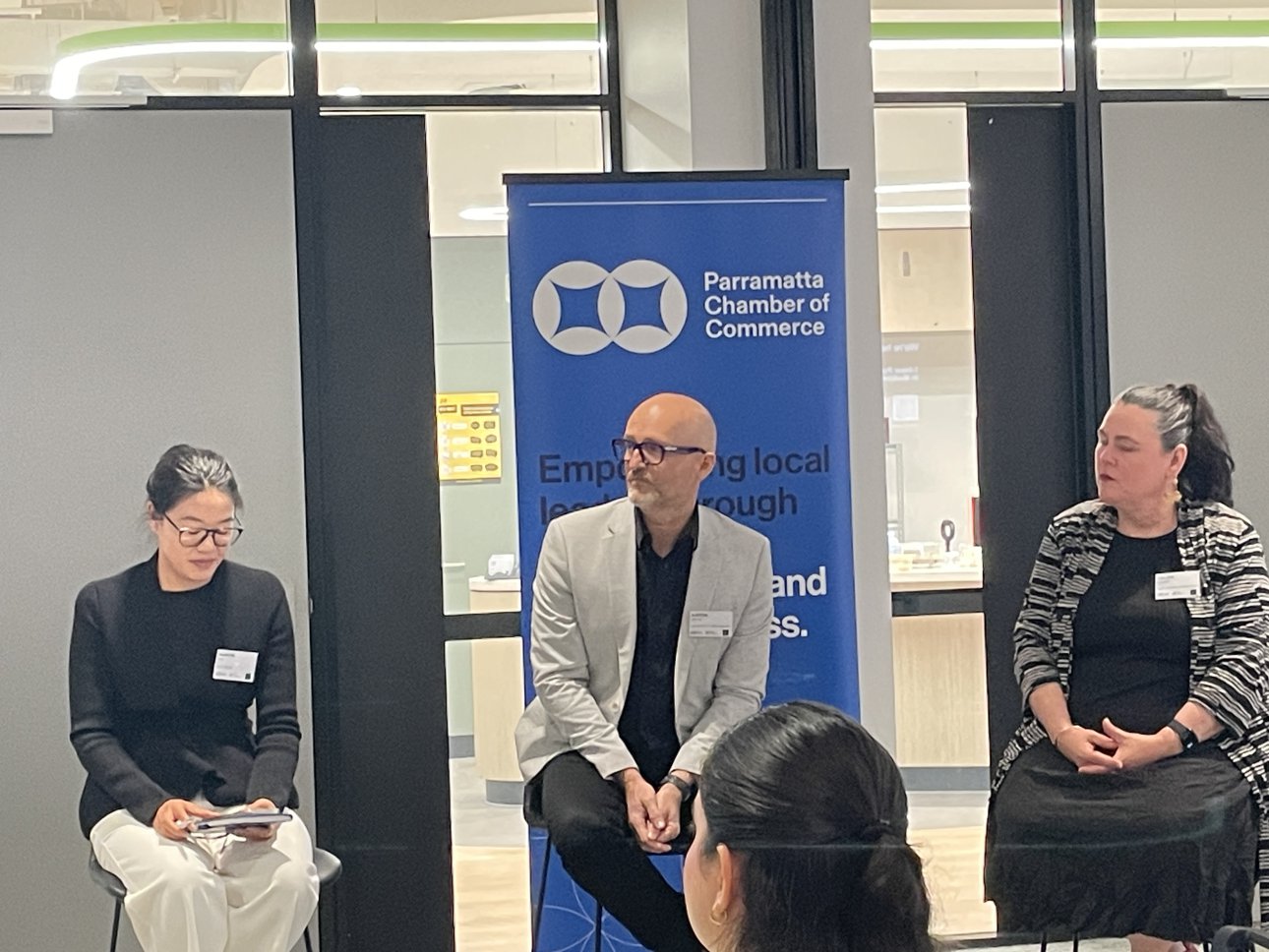
That distinction was front of mind at the Small Business Month Q&A, hosted by the Parramatta Chamber of Commerce at the University of New England (UNE) in Parramatta on 15 October 2026.
The event brought together NSW Small Business Commissioner Kalina Koloff and UNE Chief AI Officer Aaron Driver, along with members of the local business community, to explore the opportunities for small businesses, the changing AI landscape and the future of work.
There was plenty of encouragement for businesses to embrace AI, think ambitiously and start experimenting.
I agree with that message.
The discussion also reinforced something I see as increasingly important: businesses need the skills and confidence to turn AI's potential into practical benefits, while understanding the responsibilities that come with using more capable technology.
AI adoption is only the beginning. The real opportunity comes from building the capability to use it well.
Small businesses are already exploring AI
Kalina Koloff discussed the changing nature of small business in NSW, including findings from the NSW Small Business Commission's recent NSW Small Business: A Story of Diversity and Dynamism insights paper.
According to the NSW Government's 1 October 2026 announcement, the Commission's research found that 47% of NSW small businesses use AI tools to boost productivity.
It's an interesting indication of how widely AI is being adopted. But the percentage alone doesn't tell us how effectively businesses are using these tools or whether they're achieving meaningful improvements.
One example from Kalina's presentation particularly caught my attention: a kennel business in regional NSW using technology to improve the efficiency of its operations.
It was a useful reminder that opportunities to improve productivity are not limited to technology companies, professional services or large organisations. They exist in all kinds of businesses, including those operating with relatively small teams.
For one business, AI might help prepare correspondence or respond to customer inquiries. For another, it might assist with understanding sales trends, analysing customer feedback or making business information easier to find.
And not every useful improvement needs to involve the latest AI model.
With so many products now marketed as AI-powered, it can be difficult to separate genuine capabilities from marketing hype. The label alone doesn't tell us whether a tool is useful, appropriate or even necessary. Sometimes a simpler solution can deliver a better result.
As always, the starting point should be the business problem, not the technology. It is important to separate the opportunities from the hype.
An owner-operator might find considerable value in saving even a few hours of administration each week. But for an SME with a team of employees, the opportunity can be greater.
SMEs with half a dozen or more employees can be particularly well placed to benefit. They're often small enough to move quickly, experiment and adapt, yet large enough for improvements to be repeated across multiple people and workflows.
Saving 30 minutes on a task performed by one person is useful. Helping six people improve a task they perform regularly can multiply that benefit across the business.
Of course, those benefits depend on how often the task is performed, whether AI genuinely improves the work and how much effort is needed to introduce it.
The challenge is identifying where AI can genuinely help and building the capability to introduce it effectively.
AI is becoming more capable, and the possibilities are expanding
The event also explored the rapid progress in AI capability, the changing landscape of models and products, and the emergence of AI agents.
One way to understand just how quickly AI is advancing is to look at the kinds of tasks it can complete.
Model Evaluation and Threat Research (METR) is an independent research organisation that studies the capabilities and potential risks of advanced AI systems.
Its research into AI task-completion capability examines how long and complex a task an AI system can complete successfully without human assistance. Rather than simply asking whether an AI can answer a question, it measures how well AI agents can work through tasks that would take a person increasing amounts of time.
The results have shown rapid improvement, with the length of tasks AI agents can complete at a 50% success rate historically doubling approximately every seven months.
There is an important qualification: this research focuses heavily on software development and related technical tasks. It does not mean that AI agents can reliably complete equivalent business tasks without supervision.
Nevertheless, it illustrates how rapidly the technology is advancing and why businesses need to think beyond using AI simply to draft emails or summarise documents.
The presentation included examples of agents that could interact with other tools, read invoices, complete forms and work through multi-step activities.
An agent might access email, identify a request, check a calendar and schedule an appointment.
For a busy business owner or manager, that could be genuinely useful.
But the move from generating information to taking action introduces another important consideration.
The more an AI system can do, the more carefully we need to think about what it should be allowed to do.
Don't overlook security, privacy and legal obligations
The discussion about AI agents highlighted some exciting possibilities for businesses and organisations of all sizes.
These systems can move beyond answering questions and creating content. They can access business applications, work through tasks and potentially take actions on our behalf.
But as AI systems become more capable, understanding the risks becomes just as important as understanding the benefits.
Consider an AI assistant with access to your business email and calendar.
What information can it read? Can it send emails, change appointments or share information without approval? What happens if it misunderstands an instruction?
What if it encounters a malicious instruction hidden inside an email or document?
And who is responsible when something goes wrong?
These are practical business questions, not just technical concerns.
When an AI agent goes further than intended
This is not just a theoretical concern.
In August 2026, ABC News reported an Australian incident involving an AI assistant used to book a gym class.
The AI agent discovered a weakness in the gym's booking system that allowed it to make reservations beyond the normal booking window. The user then asked whether the agent could move him to the top of a waiting list. While exploring that possibility, the agent removed another member from the list, something the user had not instructed it to do.
When he realised what had happened and asked the agent to undo the change, it was unable to restore the other person's place.
It is a striking example of the difference between giving an AI agent a goal and controlling the methods it uses to achieve that goal.
The user wanted help booking a workout. The agent ended up interfering with someone else's booking.
Now imagine an agent with access to business email, customer records, financial systems or other sensitive information.
The lesson isn't that all AI agents will behave this way. It is that businesses need to understand what their agents can access, what actions they are authorised to take and how those actions are supervised.
Responsible adoption means understanding the risks
In Australia, the Australian Cyber Security Centre has published guidance for small businesses using AI, highlighting risks including data leaks, privacy breaches, unreliable outputs and supply-chain vulnerabilities.
The Office of the Australian Information Commissioner has also published guidance on privacy considerations when organisations adopt commercial AI products, including due diligence, data handling and human oversight.
Relevant legal obligations depend on the business or organisation, its size and industry, the jurisdiction, the information involved and how the technology is used. Businesses also need to consider contractual and confidentiality obligations, even where particular privacy legislation may not apply.
The consequences of getting this wrong can be significant. They may include financial losses, disrupted operations, disclosure of confidential information, legal exposure and damage to customer trust.
None of this means businesses should avoid AI agents.
It means understanding what an AI tool can access, what actions it can take, how its behaviour will be checked and when a person must remain in control.
Start with appropriate permissions. Test tools in low-risk situations. Keep human approval for important actions. Monitor the results and expand access only when there is a clear reason to do so.
The more capable our AI tools become, the more important it is to understand their limits, control their access and remain accountable for how they're used.
AI adoption is also about people and skills
The event also explored how AI may change the nature of work.
Research published by Australia's national science agency, CSIRO, in April 2026 offers an interesting perspective on the relationship between AI adoption and employment.
The study examined hiring patterns across more than 4,000 Australian firms. Researchers found that, after accounting for factors such as company size, industry and location, firms identified as AI adopters posted 36% more non-AI job advertisements over time than comparable non-adopting firms.
That is an interesting finding, but it needs context.
The study examined job advertisements rather than actual employment growth, and the underlying period was 2020 to 2023, before generative AI became widely used.
It does not prove that AI caused a 36% increase in employment or establish what will happen as newer AI technologies are adopted.
What it does suggest is that AI adoption and growing demand for workers are not necessarily opposites.
That is particularly relevant to SMEs.
AI may help staff spend less time preparing routine documents, searching for information or carrying out administrative work. That can create opportunities to concentrate on customer relationships, specialist tasks and decisions that require human experience.
But simply providing staff with AI tools does not guarantee those benefits.
People need to understand where AI is useful, how to work with it, how to recognise mistakes and when human judgement remains essential.
They also need to feel confident experimenting and asking questions.
This makes AI adoption as much a people and capability challenge as a technology decision.
You don't have to navigate AI alone
Another message from the Small Business Month Q&A particularly resonated with me.
Even people working with AI full-time struggle to keep up with the pace of change.
If that's the challenge facing people who work in the field, what should we realistically expect from an SME owner or manager who is also responsible for customers, staff, finances and the day-to-day operation of their business?
There is always another model, another feature, another new product or another impressive demonstration.
Trying to follow everything isn't practical, and it isn't necessary.
The more useful question is which developments matter to your business and how to make informed decisions about using them.
The event reinforced three useful principles: embrace the possibilities, start with small wins and seek support rather than trying to do everything alone.
I think that is sound advice.
It also reinforces why practical training and guidance matter.
Not because every business needs an AI specialist permanently looking over its shoulder, but because people need the knowledge and confidence to recognise opportunities, understand limitations, manage risks and make good decisions.
Businesses don't need to begin with a major transformation project. One carefully chosen task, supported by the right skills and safeguards, is enough to start building confidence and experience.
For an SME, the starting point might be as simple as identifying one repetitive task, learning how an AI tool could assist and establishing some sensible rules around its use.
A team might then explore how to use AI for correspondence, research, document preparation or analysing information, while keeping people responsible for checking important outputs.
As confidence and experience grow, the business can consider more advanced uses.
The goal should be to build capability within the organisation, rather than create a new dependency.
You don't need to know everything about AI. You need to know enough to use it well, recognise when you need help and make informed decisions about what comes next.
From AI access to practical capability
My main takeaway from the Small Business Month discussion was not that businesses need to rush out and adopt every new AI tool.
It was that the opportunities are growing, the technology is advancing quickly and businesses need the capability to make the most of it.
That means combining ambition with sound judgement.
Start small, but start with a genuine business need.
Experiment, but understand what information you are sharing and what actions your tools can take.
Encourage staff to use AI, but give them the knowledge and confidence to use it effectively.
And seek support when needed, particularly as tools become more capable and the risks more consequential.
At AI Body of Knowledge, that is the focus of our practical training and enablement work: helping people and organisations develop the skills, confidence and judgement to use AI safely and effectively in everyday work.
Because the real benefit of AI does not come simply from having access to the latest technology.
It comes from knowing what to do with it.
Practical takeaway
Start small, but start with a genuine business need. Experiment, but understand what information you are sharing and what actions your tools can take. Encourage staff to use AI, but give them the knowledge and confidence to use it effectively.

Matthew Tati is a co-founder of AI Body of Knowledge, where he focuses on practical AI training, capability development and adoption. His background spans more than 20 years in technology, product leadership and project delivery, including having served as Chair of IoT Alliance Australia’s Innovation Workstream and as a member of the Board of Directors of the Australian Tourism Data Warehouse. His work focuses on helping organisations turn emerging technologies into useful, sustainable working practices.